Guides
Restoring a Neglected or Overgrown Family Grave
Headstone cleaning from £75 — before & after photos with every visit.
No need to attend. Free written quote, usually within 24 hours.
In short: A neglected grave can almost always be brought back. We clear the overgrowth, clean the stone safely by hand, repair any structural damage, restore faded lettering, then keep it cared-for with a maintenance plan so it never slips back. The work is done in sensible stages after a free, no-obligation assessment. A single clean starts from £85, re-erecting a leaning stone from £150, re-gilding lettering from £95, and a maintenance plan from £45 per quarter; a full restoration is quoted once we have seen the grave.
There is a particular feeling that comes with rediscovering a family grave you haven’t been able to visit for years — perhaps a grandparent’s, perhaps an ancestor you only recently traced. The plot has vanished under brambles and ivy, the headstone is green and the names are hard to read, and the sadness arrives mixed with guilt. We see this often, and we want to reassure you of two things: it is far more common than you think, and it is almost always fixable.
This guide explains exactly how a full restoration works, stage by stage, so you know what is possible and what to expect before you commit to anything.
How a full grave restoration works, stage by stage
A neglected memorial rarely needs everything at once, and a good restoration is never rushed. We work through it in order, checking in with you at each point, so you only pay for what the grave actually needs.
1. Assess and photograph. Every restoration begins with a careful look in person. We identify the stone type — marble, granite, limestone, sandstone or slate all behave differently — and record the overgrowth, any cracks, lean or sinking, and the state of the inscription. We photograph everything and talk you through what we have found. This assessment is free and carries no obligation, and it is the moment we give you an honest view of what can realistically be achieved.
2. Clear the plot. Before any cleaning can happen, the grave has to be reachable. We remove weeds, brambles, ivy, self-seeded saplings and accumulated debris, and tidy the surround so the memorial and its kerbs are fully exposed. Ivy in particular can root into mortar joints and lift stone, so it is taken back carefully rather than ripped away. With the plot cleared, the true condition of the memorial is finally visible — and it is often in far better shape underneath than families fear. We clear overgrown plots across London; see grave cleaning at Walthamstow Queens Road Cemetery.
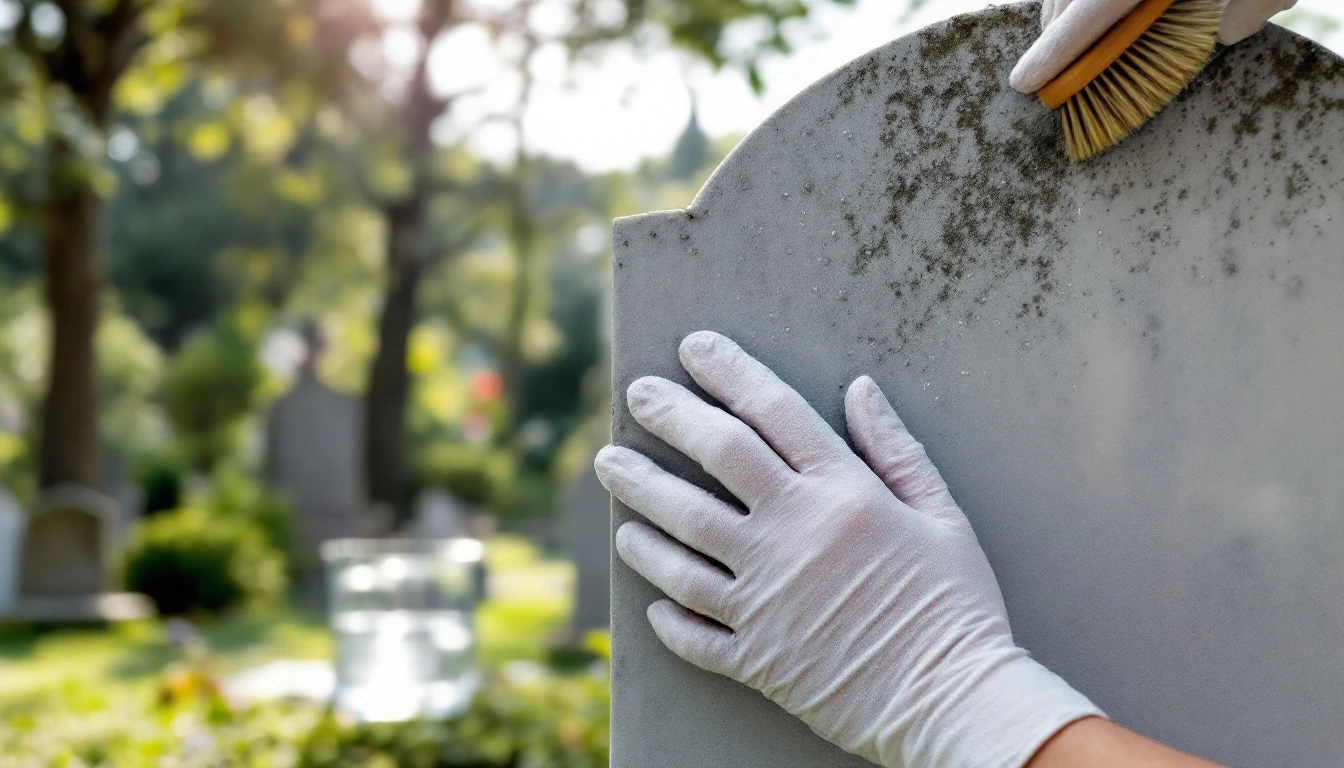
3. Clean the memorial. With the stone exposed, we clean it using conservation-grade, pH-neutral, biologically-safe products, applied by hand and worked gently to lift algae, moss, lichen and black crust. We never use a pressure washer — the force drives water into the stone and can ruin a soft memorial permanently. This is patient work, and on a heavily soiled stone it can take more than one pass. You can read what a careful clean involves on our grave cleaning service page, and our guide on how to clean a headstone explains the method in more detail.
4. Repair structural problems. Years of neglect and the London weather take a toll. Freeze-thaw cycles crack stone, ground movement leaves headstones leaning or sunken, and old kerb sets shift and gape. We assess stability and, where needed, re-set and re-fix the memorial so it is safe and square again. Re-erecting a leaning or fallen headstone starts from £150, with larger repairs quoted after assessment. We obtain the cemetery permits this work requires. See our headstone repair and restoration service, and our guide to headstone repair in London for what the process looks like. Families with a grave at Putney Lower Common can start with our page on memorial care at Putney Lower Common Cemetery.
5. Restore the lettering. A clean, stable memorial whose inscription has faded to near-invisibility still doesn’t do its job. We repaint worn lettering or re-gild gold-leaf inscriptions so the names and dates are legible once more. Re-gilding starts from £95 and a fresh inscription from £120. This is often the stage that moves families most, because it is the moment the people named there feel present again. Our headstone lettering and gilding service covers the options. Families who want a portrait beside the names can read about ceramic photo plaques for headstones.
6. Keep it cared-for. Restoration is only worthwhile if the grave doesn’t slide straight back into neglect — and in a damp climate, an untended stone greens over within a year or two. A maintenance plan from £45 per quarter keeps the memorial clean, the plot tidy and small problems caught early, so the work you have just paid for lasts. Because the stone never falls back into heavy soiling, each visit is lighter than a one-off clean. Our grave maintenance plans are designed exactly for this, and they are a relief for families who live far from London.
An honest word about what’s achievable
We will always be straight with you. Most neglected graves restore beautifully, but a very weathered stone — one where the surface has eroded or the lettering has been worn away by a century of rain — may not fully return to how it once looked. Where that is the case, we will say so at the assessment and explain what improvement is realistic, rather than take your money for a result we can’t deliver. Sometimes the right answer is a thorough clean and a fresh inscription rather than chasing a finish the stone can no longer hold. Our guide to adding a new inscription to a headstone explains how that works.
What a restoration costs
There is no single price for a restoration, because no two neglected graves are the same. What we can give you are the real starting points for each piece of work:
| Stage | Starting price |
|---|---|
| Single clean | from £85 |
| Re-erecting a leaning or fallen stone | from £150 |
| Re-gilding faded lettering | from £95 |
| Quarterly maintenance plan | from £45 / quarter |
A full restoration combines whichever of these the grave needs, so we quote it as a whole once we have seen it in person. There are no hidden extras and travel anywhere within the M25 is included. You can see every starting figure on our pricing page, and we confirm the exact cost in writing before any work begins.
If you have found a family grave that has fallen into neglect, you don’t have to face it alone or work out the right order of things yourself. Tending a forgotten ancestor’s grave is also the heart of Qingming; see what Qingming (Tomb-Sweeping Day) is. Request a free assessment and we will look at the grave, photograph it, explain honestly what can be brought back, and give you a clear plan and price — with no obligation and no pressure.
Frequently asked questions
- Can a very old or badly overgrown grave really be saved?
- Almost always, yes. We regularly restore graves that have been untended for decades, and overgrowth — however dense — is rarely the real problem; it is usually hiding a memorial in better condition than the family expected. The honest exceptions are stones whose surface has eroded so far that detail cannot be recovered, and we will tell you plainly if yours is one of them.
- Do I need permission to restore a grave?
- You generally have the right to care for a grave you are responsible for, but you do not own the land, and structural work — re-erecting or re-fixing a memorial — needs the cemetery or churchyard's consent and a permit. We are familiar with the major London cemetery operators' rules and obtain the necessary permits as part of the job. Our guide on permission to clean a grave in London covers this in full.
- How much does a full restoration cost?
- It depends on what the grave needs. Individual stages start from £85 for a clean, £150 to re-erect a leaning stone and £95 to re-gild lettering, but a complete restoration is quoted as a whole after a free assessment, so you get one clear price for the work rather than guesswork.
- Can you keep the grave maintained afterwards?
- Yes, and we strongly recommend it. A maintenance plan from £45 per quarter keeps the memorial clean and the plot tidy year-round, so the restoration you have invested in lasts. It is especially valuable if you cannot visit often, and every visit includes before-and-after photographs and a written report.
Headstone cleaning from £75 — before & after photos with every visit.
No need to attend. Free written quote, usually within 24 hours.
About the author
Practical guides written collectively by Memorial Guardian London's memorial care specialists, drawing on their day-to-day work cleaning and conserving graves and headstones across all 32 London boroughs.